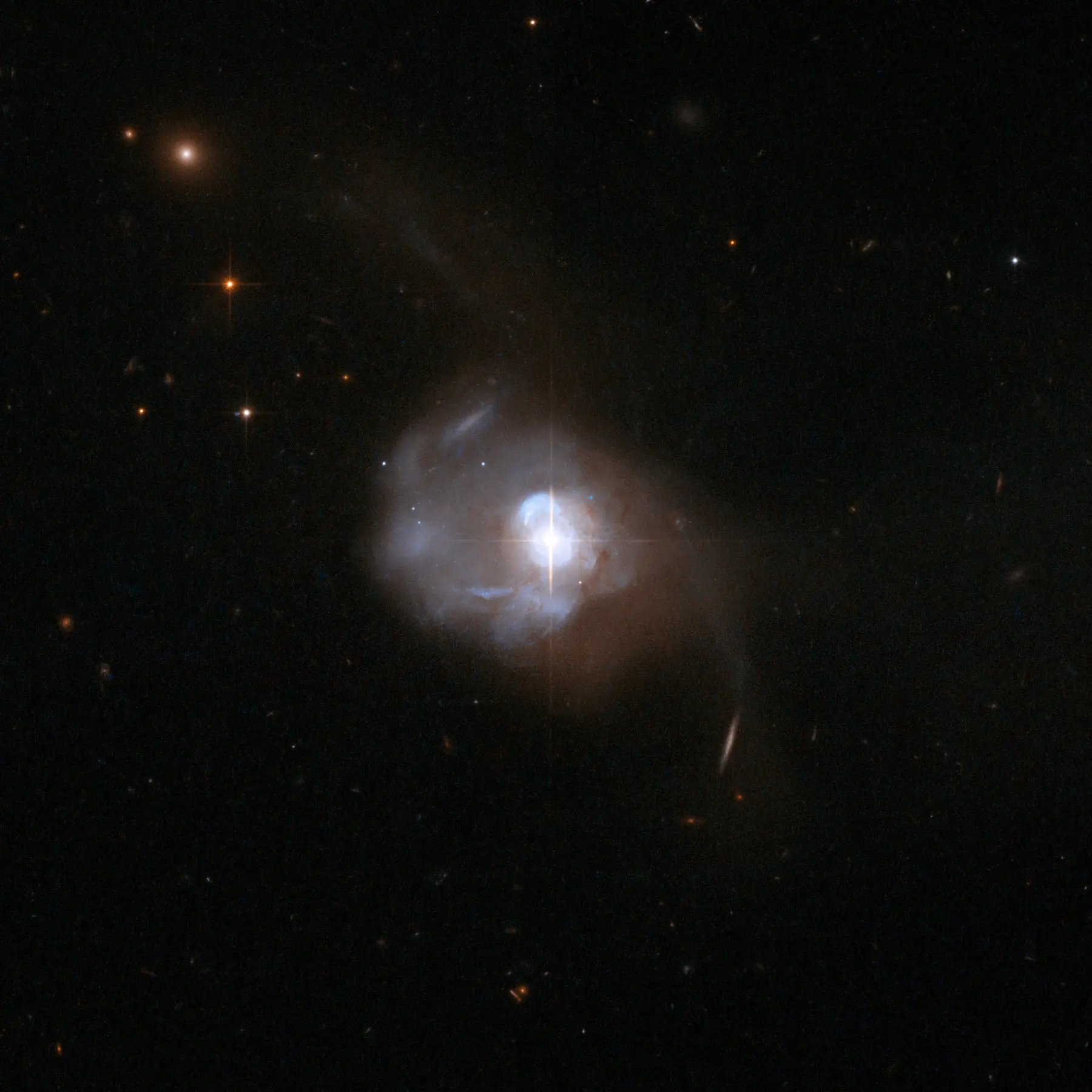
The nearest quasar · Ursa Major
A galaxy in transformation.
A black hole, a starburst, and a galaxy-wide wind converge in one unusually nearby cosmic laboratory. Markarian 231 shows how mergers can ignite quasars - and how quasars push back.
MRK 231J2000
- Right ascension
- 12h 56m 14.23s
- Declination
- +56° 52′ 25.24″
- Redshift
- z ≈ 0.04217
- Also cataloged as
- UGC 8058 · IRAS 12540+5708
Hubble image: NASA, ESA, the Hubble Heritage Team (STScI/AURA)-ESA/Hubble Collaboration, and A. Evans (University of Virginia, Charlottesville/NRAO/Stony Brook University)
01 / Overview
One galaxy.
Many extremes.
Markarian 231 is a late-stage, gas-rich merger. Enormous quantities of gas and dust have been driven inward, feeding rapid star formation and at least one rapidly accreting supermassive black hole.
Its scientific power comes from coexistence: processes that are often studied in separate, distant objects can be connected here in one system.
Scientific certainty Observed Estimated / model-dependent Under active debate
Major merger
A disturbed asymmetric host and long tidal structures preserve the evidence of a violent galactic interaction.
ObservedLuminous quasar
A type-1 BAL/FeLoBAL active nucleus radiates at a commonly adopted ≈1.1 × 10⁴⁶ erg/s.
ObservedInfrared powerhouse
Its ≈3 trillion-solar-luminosity infrared output firmly places it in the ULIRG class.
ObservedCompact starburst
Roughly 60-170 solar masses of new stars may form each year, depending on tracer and aperture.
Estimated02 / Multiwavelength anatomy
One object. Seven windows.
Different wavelengths reveal different layers of the same event. Select a band to move through the evidence.
01 / 07
Radio
What we see
A variable compact core, a strongly bent parsec-scale jet, H I absorption, an OH megamaser environment, and extended star-formation-related emission.
What it reveals
Jet geometry, neutral gas, circumnuclear structure, and how a low-power jet transfers energy into dense interstellar material.
VLA · VLBA · WSRT · MERLIN
03 / Feedback laboratory
A wind that changes the galaxy.
Markarian 231 connects a very fast inner wind to a slower, vastly more massive molecular outflow on galactic scales. Their comparable-order kinetic power is consistent with energy-conserving feedback.
Gas-rich merger
Gravity removes angular momentum
Dense nuclear gas
Fuel concentrates near the center
Starburst + quasar
Stars form as the black hole accretes
Disk wind + radio jet
Fast mechanical feedback begins
Multiphase outflow
Molecular, atomic, ionized, and X-ray gas
Escape or recycle
Depletion, turbulence, or a galactic fountain
This is a scientific synthesis of observed links - not a claim that every causal step has been uniquely measured.
Velocity comparison
One outflow, many phases
X-ray ultra-fast outflow≈20,000 km/s
BAL / FeLoBAL gasup to ≈8,000 km/s
OH molecular windat least ≈1,400 km/s
H I atomic windup to ≈1,300 km/s
CO molecular outflowabout ≈1,000 km/s
The obstructed jet
Radio quiet does not mean dynamically quiet.
Very-long-baseline observations reveal a compact jet whose position angle changes by nearly 60°. It advances at no more than about 0.013c and appears to be impeded by the dense circumnuclear medium.
- Extent
- Tens of parsecs
- Flaring power
- Approaches 10⁴³ erg/s
- Likely environment
- Dense, rotating, clumpy gas
04 / An open question
Candidate · not confirmedOne black hole - or an extraordinarily close pair?
A close-binary supermassive black hole is astrophysically plausible in a merger, but no cited study directly resolves two black holes or supplies an uncontested orbit.
+ Why it remains intriguing
- An unusual optical/UV spectral deficit inspired a circumbinary-disk model in 2015.
- A reported ≈1.1-year optical periodicity revived interest in 2020.
- A 2025 polarimetric model reproduces wavelength-dependent polarization and predicts a second far-UV polarized-flux peak.
? Why it remains unproven
- The UV continuum remained remarkably stable across several proposed orbital periods.
- The expected large orbital shift in the Lyα line did not appear.
- Energetic tests found the directly observed far-UV source too weak to power key infrared emission.
- Quasar variability can imitate short periods; no pair has been spatially resolved.
A recent major merger with at least one rapidly accreting supermassive black hole.
The merger may have delivered a second black hole into the nucleus.
UV structure, periodicity, and polarization can be modeled with a close binary.
No direct resolution or uncontested orbital solution currently confirms the pair.
The uncertainty is not a weakness in the story. It is the science.
05 / Field notes
Ten remarkable facts.
Each fact is drawn from the supplied research report; uncertain claims remain labeled as estimates, reports, or active hypotheses.
The nearest quasar
Standard NASA and literature descriptions call Mrk 231 the nearest quasar to Earth, making it unusually accessible for detailed study.
Four identities at once
It is simultaneously a quasar, an ultraluminous infrared galaxy, an intense starburst, and a major galaxy merger.
A hard-to-weigh black hole
Widely used mass estimates span more than an order of magnitude: roughly 1.7 × 10⁷ to 2.3 × 10⁸ solar masses.
A wind at 6-7% of light speed
The fastest detected nuclear outflow reaches about 20,000 km/s and may power the slower, far more massive galactic wind.
A remarkable mass flow
Hundreds of solar masses of molecular gas per year may participate in the outflow - far more than the black hole consumes.
A galactic fountain
One CARMA analysis estimates only about 15% of the molecular outflow exceeds escape speed; much of the gas may fall back and recycle.
A trapped radio jet
Its compact jet bends by nearly 60° and appears obstructed by the dense gas surrounding the nucleus.
A wind in many phases
X-ray, BAL, ionized, atomic, OH, CO, HCN, and other molecular tracers reveal one of the richest known multiphase outflows.
A possible oxygen first
A 12σ spectral feature has been reported and interpreted as the first extragalactic molecular-oxygen detection, linked to the outflow.
A hypothesis that keeps evolving
The binary-black-hole idea was proposed in 2015, strongly challenged in 2016, revived in 2020, and reframed with a testable prediction in 2025.
06 / Research timeline
A story rewritten by every wavelength.
Filter the milestones to follow the galaxy, its outflows, the binary debate, or the observatories that changed the picture.
Galaxy
Strong infrared and millimeter emission establish an extraordinarily luminous active system.
Galaxy
Merger morphology, an OH megamaser, and compact nuclear structure come into focus.
Galaxy
Sub-kpc radio, H I, and molecular studies reveal a compact rotating gas and star-forming disk.
Galaxy
Adaptive-optics near-IR work resolves a compact young stellar disk and recent nuclear star formation.
Outflows
Broad CO wings and Herschel spectroscopy establish Mrk 231 as a prototype molecular-outflow galaxy.
Observatories
NuSTAR plus Chandra constrain the nucleus and establish its extreme intrinsic X-ray weakness.
Outflows
Researchers connect the ≈20,000 km/s nuclear wind to the ≈1,000 km/s molecular outflow.
Binary debate
A 590-AU close-binary model is proposed to explain the unusual optical/UV spectrum.
Binary debate
UV stability, missing orbital line motion, and energy-budget tests strongly challenge the original model.
Binary debate
Reported ≈1.1-year optical periodicity revives interest, while an O₂ interpretation expands the chemistry story.
Outflows
VLBI analysis maps a curved, slow-advancing radio jet obstructed by dense circumnuclear gas.
Observatories
JWST/MIRI adds spatially resolved mid-IR spectroscopy of the nucleus and outflowing gas.
Binary debate
Polarimetric modeling proposes a revised binary and a falsifiable far-UV signature.
The observing network
HubbleChandraNuSTARXMM-NewtonHerschelIRAM / PdBINOEMACARMAVLA / VLBAJWST / MIRI
Instrument credit matters: the canonical molecular-outflow results highlighted here came from PdBI/IRAM, NOEMA, and CARMA - not generically from ALMA.
07 / Scientific foundation
Follow the evidence.
Observatory pages orient the story and supply imagery. Quantitative claims are anchored to the peer-reviewed studies that made the measurements.
01Orientation + image
NASA Science - Quasar Host Galaxy Markarian 231
Coordinates, public-facing distance, Hubble data, and host-galaxy imagery.
Open source02Feedback
Feruglio et al. (2015) - The multiphase winds of Markarian 231
Nuclear ultra-fast outflow and molecular-wind energetics.
Open source03X-ray nucleus
Teng et al. (2014) - NuSTAR view of Mrk 231
X-ray weakness, absorption, AGN luminosity, and black-hole mass context.
Open source04Molecular gas
Alatalo (2015) - CARMA-resolved CO outflow
Outflow versus escape, gas recycling, and depletion timescales.
Open source05Radio jet
Wang et al. (2021) - The obstructed jet in Mrk 231
Jet geometry, bending, advance speed, and jet-ISM interaction.
Open source06UV / binary test
Veilleux et al. (2016) - Complete UV spectrum
BAL phenomenology and major spectroscopic tests of the original binary model.
Open source07JWST
Alonso-Herrero et al. (2024) - MICONIC JWST/MIRI study
Spatially resolved mid-IR view of the nuclear environment and gas motions.
Open source08Open question
Biedermann, Marin & Barnouin (2025) - Polarimetric binary model
A recent model revival and a testable far-UV polarization prediction.
Open sourceHow to read the numbers on this site
Measurements in an active, dusty merger are inherently model-dependent. Distance shifts with cosmology; star-formation estimates depend on aperture and AGN subtraction; black-hole masses depend on the chosen scaling method; and outflow rates depend on geometry, inclination, radius, and gas-conversion assumptions.
Values are therefore rounded, expressed as literature ranges where appropriate, and paired with certainty labels. “Consistent with” does not mean “uniquely proven,” “outflowing” does not always mean “escaping,” and a close binary remains a candidate rather than a confirmed system.
Research synthesis reviewed August 2026 · Measurements may change as new observations are published.